Benefits of Hiking in Nature: Why Greece's Mountains and Sea Belong Together
There are moments on a Greek hiking trail when the landscape seems to change everything.
You leave the noise of a city behind and begin walking beneath pine and fir trees. The air smells different. Your breathing slows. Hours later, the trail descends towards the sea, and suddenly the mountains open onto blue water.
You swim, walk barefoot on warm sand, and watch the light change across the horizon.
This is one of the many benefits of hiking in nature.
Beyond the scenery and physical exercise, spending time in natural environments exposes us to fresh air, natural aromas, sunlight, movement and sensory experiences that can support relaxation and overall well-being.
Greece, with its extraordinary combination of mountains, forests and coastline, offers a particularly unique environment in which to experience these benefits.
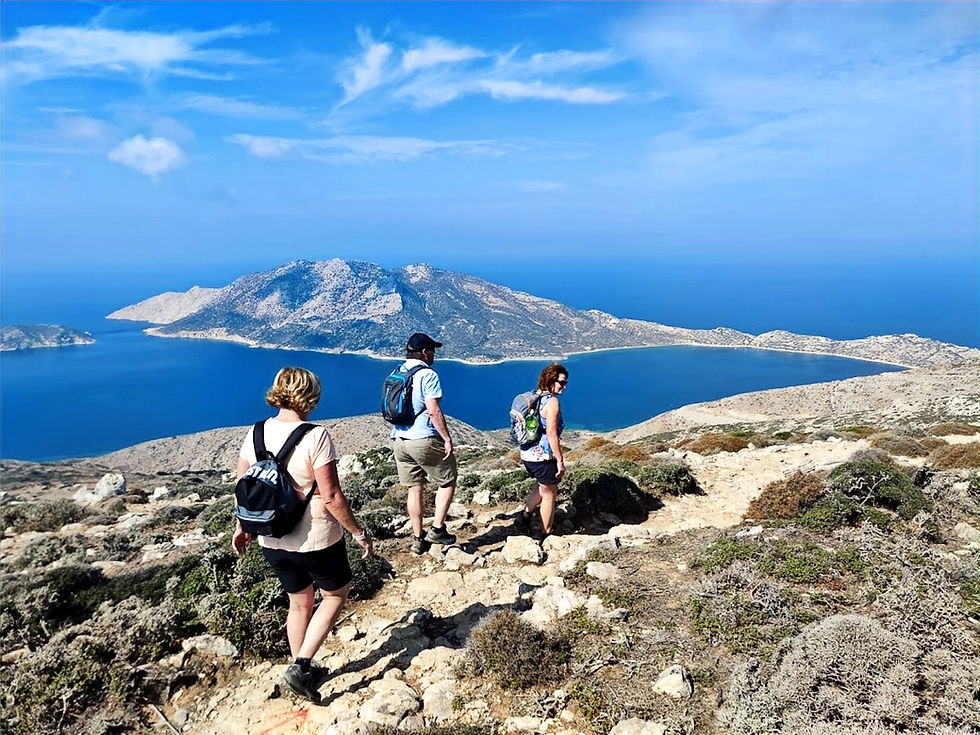
The Benefits of Hiking in Nature Begin with the Environment Around Us
When we think about hiking, we usually focus on physical fitness, endurance and reaching a destination.
But the benefits of hiking in nature extend beyond exercise.
A natural environment constantly interacts with our senses and nervous system.
The sound of waves, the scent of pine trees, changing temperatures, uneven terrain and natural light all create a different experience from spending time indoors or in an urban environment.
This combination of physical movement and environmental exposure is one of the reasons why hiking can be such a powerful way to disconnect from everyday stress.
Benefits of Being by the Sea: More Than Just Salt Water
For centuries, people have been drawn to the coast for relaxation and perceived health benefits.
Modern research suggests that several aspects of the marine environment may contribute to well-being.
The Benefits of Sea Air
When waves break against the shore, they generate tiny airborne droplets known as sea spray aerosols.
These droplets contain seawater components, including salts and other natural compounds.
Coastal air is also influenced by humidity, wind and the constant movement of water. For many people, breathing near the sea feels noticeably different from breathing in an urban environment.
It is important not to exaggerate the science. There is no strong evidence that sea air delivers significant quantities of minerals into the bloodstream or acts as a treatment for respiratory conditions.
The benefits of sea air are more likely connected with the wider outdoor environment: fresh air, movement, relaxation and reduced exposure to indoor stressors.
Sometimes the benefit is not one particular molecule.
It is the entire environment.

Negative Air Ions and Moving Water
Waterfalls, breaking waves and storms naturally generate negative air ions, electrically charged particles found in the atmosphere.
Researchers have investigated their possible influence on mood, stress and certain aspects of respiratory function. Results remain mixed, and there is still much to learn.
What is certain is that moving water creates a unique sensory environment.
The sound of waves is repetitive rather than demanding. Wind stimulates the skin. Light reflects continuously from the surface of the sea.
Our nervous system responds to all of these signals.
This is another reason why spending time outdoors can feel restorative.
Can We Absorb Magnesium from Seawater?
This is one of the most common claims associated with seawater bathing and wellness.
Seawater contains magnesium, but scientific evidence that significant quantities are absorbed through intact human skin during ordinary swimming or bathing remains limited.
The skin is an effective protective barrier.
That does not diminish the value of swimming in the sea.
Water provides gentle exercise, resistance and buoyancy. Temperature stimulates the body. Floating encourages relaxation. Sunlight and fresh air influence our daily rhythms.
The ocean may not be a nutritional supplement, but it can be an exceptionally enjoyable environment for recovery and relaxation.
Grounding: Walking Barefoot on the Earth
There is something instinctively satisfying about walking barefoot on a beach.
The practice known as grounding or earthing has become increasingly popular, based on theories that direct contact with the Earth's surface may influence the body electrically.
Some preliminary studies have explored possible effects on sleep, inflammation and stress, but the scientific evidence remains limited.
The benefits we can confidently identify are simpler.
Walking barefoot stimulates the feet, improves sensory awareness and reconnects us physically with the terrain beneath us.
Sand, grass, stone and soil all feel different.
In a world increasingly dominated by artificial surfaces and indoor environments, that direct contact can be surprisingly restorative.

Forest Bathing Benefits: What Trees Release Into the Air
The sea surrounds us with movement and salt.
Forests offer something entirely different: a living atmosphere filled with plant-derived compounds.
Trees constantly release volatile organic compounds into the air.
Among the most interesting are terpenes and phytoncides.
These natural substances are part of the chemical language of plants, helping them communicate and defend themselves against insects and microorganisms.
They may also influence humans.
Phytoncides and the Science Behind Forest Bathing
The Japanese practice of shinrin-yoku, or forest bathing, has attracted considerable scientific interest over recent decades.
Phytoncides are antimicrobial volatile compounds released by plants, particularly trees.
Researchers have investigated whether exposure to forest environments may influence stress hormones, immune-related markers and nervous system activity.
Studies have reported associations between forest exposure and lower psychological stress, reduced cortisol levels, improved mood, changes in certain immune-related markers and reduced blood pressure in some participants.
The research is promising, although scientists continue to investigate exactly how much of these effects comes from the chemical compounds themselves and how much comes from the wider forest environment.
A forest is not a medicine cabinet.
Its value lies in the combination of fresh air, natural aromas, movement, silence, biodiversity and the psychological experience of being surrounded by living things.

Terpenes: The Natural Fragrance of the Forest
Anyone who has walked through a Greek pine forest after rain knows the smell.
That distinctive aroma comes partly from terpenes, volatile compounds released by trees such as pine, fir, cedar and cypress.
Common examples include alpha-pinene, limonene and camphene.
Some terpenes have demonstrated biological activity in laboratory research, including antioxidant and antimicrobial properties.
However, walking through a forest should not be compared directly with consuming concentrated essential oils or medical treatments.
The important point is that forests naturally expose us to a complex atmospheric environment that is fundamentally different from an office, hotel room or gym.
This may be one reason why people often report feeling calmer and mentally refreshed after spending time among trees.
Nature and Human Health: The Role of the Nervous System
Perhaps the most important connection between nature and human well-being has nothing to do with a specific chemical.
It is the nervous system.
Modern life exposes us to continuous stimulation: traffic, screens, artificial lighting, noise, notifications and deadlines.
Natural environments operate differently.
The sound of waves is repetitive rather than demanding.
The movement of leaves provides visual complexity without requiring constant attention.
Walking along a trail requires awareness and coordination, but not the same mental effort as navigating a busy city.
Research into stress reduction and attention restoration suggests that time spent in nature can support psychological recovery.
This may explain why a few hours outdoors can sometimes feel more refreshing than an entire day indoors.
Nature gives the mind something increasingly rare:
Space to recover.

Why Hiking Between Mountains and Sea Creates a Complete Outdoor Experience
The mountains and the sea represent two different experiences.
The mountains challenge us.
They require effort, balance, endurance and concentration.
The sea invites us to slow down.
It offers movement without pressure, space without boundaries and a natural rhythm that encourages relaxation.
Together, they create balance.
A morning hike through a mountain forest engages the body and mind.
An afternoon beside the sea provides recovery.
Walking uphill strengthens us.
Swimming and floating allow us to unwind.
One environment stimulates effort.
The other encourages release.
This combination is particularly valuable in Greece, where the transition from mountain to coastline can often happen within a single day.
Greece: Where Mountains Meet the Sea
Few countries offer such an extraordinary relationship between mountains and sea.
In Greece, ancient trails often connect mountain villages with coastal settlements.
Forests cover the slopes of the mainland.
Island paths cross dry hillsides, olive groves and aromatic Mediterranean landscapes before reaching secluded beaches.
The geography itself invites exploration.
You can walk beneath fir trees in the Peloponnese, follow rugged trails in Pindos, discover traditional villages in Epirus, and later swim in the clear waters of the Aegean or Ionian Sea.
This is not simply sightseeing.
It is a way of experiencing Greece through movement and direct contact with the landscape.
The mountains provide perspective.
The sea provides openness.
The forest provides atmosphere.
Together, they offer a more complete outdoor experience.

GrEco Hiking: Private Adventures Between Mountain and Sea
At GrEco Hiking, we believe that exploring Greece should be about more than following a predetermined route.
Our private and customized hiking journeys are designed around the individual traveller.
We combine mountain trails, forests, traditional villages, coastal paths and the sea to create experiences that reflect the character of Greece itself.
Depending on the destination, a journey might include hiking through ancient fir forests and mountain landscapes, exploring traditional villages and historic trails, walking along coastal paths overlooking the Aegean, swimming at secluded beaches after a day on the trail, and discovering local food, culture and landscapes at a relaxed pace.
The objective is not to rush from one attraction to another.
It is to experience the environment.
To breathe the air.
To walk through the forest.
To feel the terrain beneath your feet.
To reach the sea after a rewarding day in the mountains.
And to return home with something more meaningful than photographs.

Explore Greece Differently with GrEco Hiking
Greece is not defined by its mountains alone, nor by its islands and beaches.
Its real character lies in the connection between them.
At GrEco Hiking, we create private, customized adventures that allow you to experience that connection for yourself.
From the forests of the Peloponnese to the mountains of Epirus and the island trails of the Cyclades, every journey is an opportunity to discover Greece more deeply.
Walk further. Breathe deeper. Experience Greece differently.
Discover our private customized hiking adventures in Greece.


Comments